Introduction
Sachin Bansal is the archetype of the modern Indian entrepreneur. As the co-founder of Flipkart, he didn't just build an online bookstore; he built the ecosystem that taught India to shop online. Often referred to as the "Sam Walton of India" for revolutionizing retail, Bansal was the tech-savvy engineer who, alongside Binny Bansal, created India's first e-commerce unicorn. His journey from a modest upbringing in Chandigarh to becoming a billionaire is a cornerstone of the Indian startup folklore.
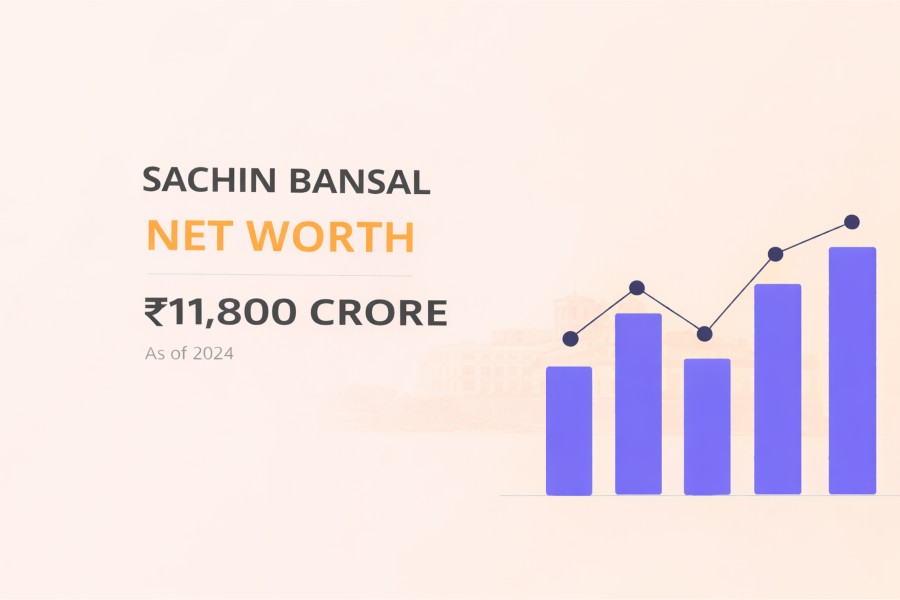
However, Sachin Bansal's net worth is a subject of constant evolution. It is not static; it fluctuates with the volatility of the stock markets, the strategic pivots of his new ventures, and the regulatory winds of the Indian tax authorities. From the massive $16 billion payday from the Walmart acquisition to the turbulent IPO of his fintech company, Navi, Bansal's financial story is a rollercoaster of high-risk bets and massive rewards. This analysis provides a deep dive into the financial anatomy of Sachin Bansal. We will explore the creation of his wealth at Flipkart, the "Great Indian E-commerce War," the complexities of the Walmart exit, the strategic diversification through BACQN (now Navi), and the tax liabilities that shadow his financial profile.
The Amazon Engineer Turned Entrepreneur
The Early Investment: Time and Brainpower
Sachin Bansal was born in 1981 in Chandigarh and graduated from the Indian Institute of Technology (IIT) Delhi in 2005 with a degree in Computer Science. His first job was at Techspan, followed by a stint at Amazon Web Services as a Senior Software Engineer. It was during his time at Amazon that he met Binny Bansal (not a relative), a fellow IITian and Amazon colleague. While their peers were climbing the corporate ladder and receiving RSUs (Restricted Stock Units) in the booming American tech giant, Sachin and Binny had a different vision.
They realized the potential of the e-commerce market in India. At the time, in 2007, the Indian internet user base was small, but the growth trajectory was promising. They quit their high-paying jobs at Amazon—a move that foregone millions in potential stock value—to start Flipkart. This initial "opportunity cost" of leaving Amazon is the first invisible investment Sachin Bansal made. He bet his time, his skills, and his career stability on an idea that was unproven in the Indian context. This risk tolerance is the foundational bedrock of his eventual wealth. If they had stayed at Amazon, they would likely be millionaires in dollars, but as entrepreneurs, they would become billionaires.
Bootstrapping and the First Million
Flipkart started in a small apartment in Koramangala, Bangalore. The initial capital was minimal, largely funded by their own savings. Sachin Bansal’s personal wealth at this stage was effectively zero. All resources were poured into buying books, developing the website, and creating the supply chain. The "wealth" generated in the early days was not cash in the bank, but "user growth" and "valuation." As they raised funds from venture capital firms like Accel Partners and Tiger Global, the company’s valuation grew. Sachin’s stake diluted with each funding round, but the value of the remaining pie increased exponentially. By 2015, Flipkart was valued at over $15 Billion, placing Sachin Bansal firmly in the Forbes list of India’s richest people, solely based on the paper value of his equity.
The Walmart Acquisition: The Financial Apex
The $16 Billion Deal
The defining moment in Sachin Bansal’s financial history was undoubtedly the acquisition of Flipkart by the American retail giant Walmart in 2018. This was the largest e-commerce deal in India at the time. Walmart acquired a 77% stake in Flipkart for $16 Billion. This deal shattered the myth that Indian startups could not provide lucrative exits for their founders.
Sachin Bansal held a significant stake in Flipkart at the time of the sale. By selling his shares to Walmart, he unlocked the value he had spent a decade building. While the exact figures of the sale were split between the two founders, reports suggest that Sachin Bansal pocketed roughly $1 Billion to $1.2 Billion from this transaction. This liquidity event transformed him from a "paper billionaire" (wealthy on paper but cash-poor) into a genuine billionaire with massive liquid assets. This cash infusion provided the capital he needed to fund his future ventures, most notably his family office, BACQN.
Leaving the Nest: The 2018 Exit
In a surprising turn of events, Sachin Bansal exited Flipkart entirely shortly after the Walmart deal. Unlike his co-founder Binny Bansal, who stayed on for a while, Sachin cut ties with the company he founded. He sold his remaining 5.5% stake to Walmart in 2019, completely cashing out. This total exit meant he no longer benefited from the subsequent growth in Flipkart’s valuation (which has nearly doubled since the Walmart acquisition). However, it also insulated him from the operational risks and losses that the company was still incurring. It was a classic "take the money and run" strategy, prioritizing financial independence and the freedom to start new projects over legacy loyalty.
-
Walmart Exit Proceeds Liquidity Event
The sale of Flipkart shares to Walmart remains the single largest contributor to Sachin Bansal's net worth. The estimated $1 Billion cash inflow allowed him to set up BACQN (Bansal Acquisition Company), his family office. This capital is the "dry powder" he uses to invest in other startups and fund his new fintech ventures. It represents the successful harvest of his first massive entrepreneurial cycle.
-
Navi Technologies Current Growth Engine
After Flipkart, Sachin Bansal focused on the financial sector. He founded BACQN, which later rebranded to Navi. Starting as a digital lending platform, Navi expanded into mortgages, insurance, and mutual funds. In 2022, Navi listed on the Indian stock exchanges via a SPAC merger. While the IPO was rocky and the stock price remains volatile, a significant portion of Sachin Bansal's current net worth is tied up in Navi’s equity.
-
Capital Gains Tax Liability Financial Drag
In 2021, the Income Tax Department raised a tax demand of roughly ₹700 Crore (approx. $95 Million at the time) against Sachin Bansal regarding the sale of his Flipkart shares to Walmart. The department treated the proceeds as "business income" rather than capital gains, which attracted higher tax rates and penalties. This liability acts as a significant deduction from his net worth. While he is contesting it, it creates a financial overhang on his wealth.
The BACQN (Navi) Empire: Building Wealth the Second Time
The Angel Investor Phase
Between leaving Flipkart and launching Navi publicly, Sachin Bansal operated as a super-angel investor. Through BACQN, he invested in over 30 startups. His portfolio includes notable names like Ola Electric (mobility), Udaan (B2B commerce), Ather Energy (EV scooters), and Vogo (bike rentals). He has a penchant for "hard tech" and logistics—industries that complement his e-commerce background.
These investments are a crucial part of Sachin Bansal's net worth. While the exact value of these private holdings is hard to pin down, they represent a portfolio of potentially high-growth assets. For instance, Ola Electric is planning a massive IPO, and Udaan is a decacorn (valued over $10 Billion). If and when these companies go public or get acquired, Bansal’s stake could multiply in value. This portfolio diversification reduces his reliance on a single company, protecting his wealth from sector-specific risks.
The Navi IPO and Market Volatility
Sachin Bansal's attempt to build a second unicorn came to fruition with the listing of Navi Technologies. However, the market reception was lukewarm. The stock listed at a discount and has struggled to find stable ground. This has a direct impact on Bansal's net worth. As the largest shareholder, his paper wealth fluctuates daily with the stock price of Navi.
Unlike Flipkart, which was sold at a peak valuation, Navi is currently a public market play. It is subject to the whims of retail investors and quarterly earnings reports. The decline in Navi's stock price from its high points has shaved off hundreds of crores from his net worth. However, it also provides liquidity; he can sell shares in the open market if he needs cash. This liquidity is a double-edged sword, offering freedom but exposing him to market volatility.
Comparative Analysis: Sachin vs. Binny
The relationship and financial paths of the "Bansals of Flipkart" have diverged significantly since the Walmart deal.
| Parameter | Sachin Bansal | Binny Bansal |
|---|---|---|
| Primary Focus Post-Flipkart | Navi (Fintech & Lending) | SaaS (Three Sigma Capital) & E-Commerce (Stryum) |
| Investment Style | Logistics & Electric Mobility (Ola, Ather) | D2C Brands & Agritech (Eka, Mosaic Wellness) |
| Current Net Worth | ~$1.1 - $1.4 Billion | ~$1.0 - $1.3 Billion |
| Public Status | Public (Navi) | Private (No public listing yet) |
While both are billionaires, their wealth structures are different. Sachin took the route of building a public fintech company (Navi) early, which puts his wealth under the microscope of the stock market. Binny has remained in the private markets, investing in early-stage SaaS (Software as a Service) companies. Sachin's wealth is arguably more volatile due to Navi's stock performance, while Binny's wealth is more opaque but potentially less exposed to daily market sentiment. However, Sachin's aggressive foray into lending through Navi gives him access to financial leverage and a regulated business model, which can be highly scalable and profitable once the market stabilizes.
Lifestyle, Assets, and Public Persona
The Reluctant Billionaire
Despite his immense wealth, Sachin Bansal maintains a surprisingly low profile. He is known for his frugality and intense work ethic. Stories of him sleeping in the Flipkart office during the early days are legendary. Even as a billionaire, he is rarely seen at high-society parties or Bollywood bashes. He prefers to stay in the background, focusing on product and strategy rather than personal branding.
His assets are largely financial (stocks, stakes in companies) rather than material (yachts, villas). He owns a luxurious house in Bangalore's upscale locality, but it is modest compared to the mansions of other billionaires. He drives electric cars (a Mahindra e2O, now a Tesla), aligning with his investment thesis on clean mobility. This lifestyle of "stealth wealth" helps him keep a low tax profile and minimizes public scrutiny, although the tax department has caught up with him regardless.
Challenges and Controversies
The Tax Men at the Door
The most significant threat to Sachin Bansal's net worth currently comes from the Indian tax authorities. Apart from the ₹700 Crore capital gains tax demand, the Enforcement Directorate (ED) has also investigated certain transactions involving Flipkart and his subsequent investments. While no charges have been proven in court, these legal battles are expensive and time-consuming. A potential adverse judgment could force him to liquidate part of his portfolio to pay dues, drastically reducing his liquid cash reserves.
Furthermore, the "angel tax" regulations in India have created friction for investors. Sachin Bansal has been vocal in criticizing these regulations, which tax capital raised by unlisted companies. These policies affect his investments and the ecosystem he funds, potentially dampening the returns on his portfolio.
The Future: From E-Commerce to Fintech
The Vision for Navi
Sachin Bansal’s goal with Navi is to create a technology-driven financial services company that challenges the traditional banking incumbents. By leveraging data and algorithms, Navi aims to offer instant credit to underbanked segments. If successful, Navi could become the "Flipkart of Finance"—a platform that democratizes access to capital.
The success of Navi is critical for his net worth to grow beyond the Flipkart payout. While the IPO stumble was a setback, the underlying business of digital lending in India is booming. As India's credit penetration increases, Navi is poised to capture a significant market share. If the market turns in Navi's favor, Sachin Bansal’s net worth could potentially double, moving him into the upper echelons of the Indian rich list.
Strategic Bets
Through his investments in Ola Electric and Ather Energy, Sachin Bansal is also betting on the future of mobility. The transition to electric vehicles (EV) in India is inevitable. As these companies scale up and go public, the returns on his early-stage investments will likely materialize, adding a secondary layer to his wealth structure. He is effectively hedging his bets across the "New India" pillars: Consumption (via his Flipkart legacy), Finance (via Navi), and Mobility (via his angel portfolio).
Conclusion: The Architect of Indian E-Commerce
Sachin Bansal's net worth is a narrative of resilience and reinvention. He had the vision to see what Amazon could become in India before Jeff Bezos did. He fought off global giants (like Amazon itself and eBay) to create an Indian champion. And when the time was right, he had the courage to sell and move on.
Today, he is in the middle of building his second empire. The wealth he accumulated from Flipkart is now the fuel for Navi. While the tax notices and stock volatility act as headwinds, his fundamental understanding of the Indian consumer market remains his greatest asset. He is not just a man who was once rich; he is an active builder whose current wealth is dynamically evolving with the Indian digital economy. Whether he reaches the heights of the Ambanis and Adanis remains to be seen, but his legacy as the man who opened India's digital purse is already secure. His financial journey is proof that in the world of startups, the real wealth isn't just the money you make, but the problems you solve.
Frequently Asked Questions
Sachin Bansal earned approximately $1 Billion (approx. ₹7,000 - ₹8,000 Crore) from the sale of his Flipkart stake to Walmart. This included the sale of his initial stake during the primary acquisition and the subsequent sale of his remaining shares in 2019.
After Flipkart, Sachin Bansal focused on his fintech venture, Navi (formerly BACQN). He runs a family office that invests in startups. He is deeply involved in the operations of Navi, which provides digital loans and mortgages, and is an active angel investor in sectors like electric mobility and SaaS.
No, Sachin Bansal and Binny Bansal are not related. They are often called the "Bansals of Flipkart" and met while working at Amazon in Bangalore. They became friends and business partners, co-founding Flipkart together in 2007.
The Income Tax Department sent a notice to Sachin Bansal demanding roughly ₹700 Crore. The department treated the proceeds from the sale of his Flipkart shares to Walmart as "business income" rather than capital gains. This classification attracts a higher tax rate, leading to the significant demand, which Bansal is contesting legally.
Navi Technologies is Sachin Bansal's fintech company, formerly known as BACQN. It offers digital personal loans, home loans, and microfinance. It also hosts an investment platform for mutual funds. It is Sachin Bansal's primary business focus post-Flipkart and is publicly listed on the Indian stock exchanges.
Final Financial Overview
Sachin Bansal remains a pivotal figure in the Indian startup ecosystem. His net worth, currently hovering around the $1.1 Billion mark, is a testament to his ability to identify market gaps. Despite the challenges of tax demands and stock market volatility, he continues to build, invest, and innovate. He represents the mature face of Indian entrepreneurship—strategic, resilient, and always looking for the next big disruption.