Introduction
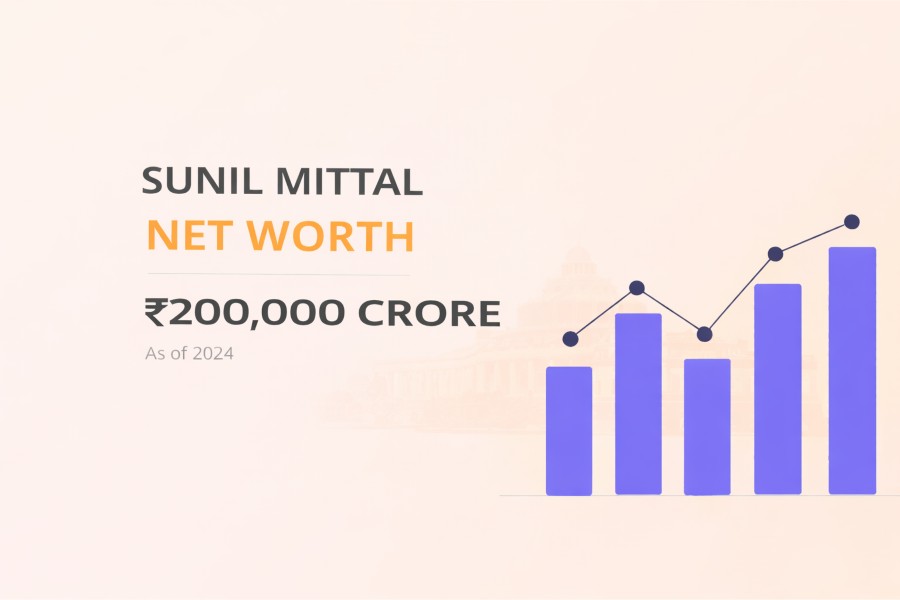
Sunil Bharti Mittal is the visionary who put a mobile phone in the hands of every common Indian. As the founder and chairman of Bharti Airtel, he is the architect of one of the world's largest telecommunications empires. With a net worth that fluctuates around the $10 billion to $14 billion mark, Mittal is not just a billionaire; he is a pioneer who democratized communication in a country of over a billion people. His journey is a classic rags-to-riches tale, but it is also a story of strategic foresight, risk-taking, and an unshakeable belief in the potential of the Indian market.
However, Sunil Mittal's net worth is not just a number on a Forbes list. It represents the transformation of the Indian economy. From the days when making a phone call cost ₹16 a minute to the era of 4G data and 5G connectivity, Mittal has been at the helm, steering his ship through regulatory storms, competitive wars, and massive global expansions. This comprehensive analysis dissects the financial anatomy of Sunil Mittal, exploring the origins of his wealth in the bicycle parts business, the massive valuation of Bharti Airtel, the impact of the AGR crisis, and his recent ventures into insurance and satellites. We will also examine how his wealth compares to his rivals and what the future holds for this telecom titan in the age of Reliance Jio.
The Entrepreneurial Spark: From Bicycles to Bandwidth
The Early Years and First Million
Sunil Mittal's story begins in Ludhiana, Punjab, in 1957. Born into a family of politicians (his father was an MP), Mittal was destined for public service, but his heart lay in business. He started young. In 1976, at the age of 18, he borrowed ₹20,000 from his father to start a small business making crankshafts for local bicycle manufacturers. This was his first lesson in manufacturing and logistics. He didn't stop there. He quickly pivoted to importing electric motors from Japan and later portable generators.
By the 1980s, Mittal had expanded into the world of telephony, albeit on the hardware side. He started selling fax machines and push-button telephones in an era where rotary phones were the norm. This exposure to the telecommunications hardware laid the groundwork for his biggest leap. He realized early on that the infrastructure was the bottleneck, not the device. This realization, combined with the Indian government's liberalization policies in the early 1990s, set the stage for the birth of Bharti Telecom. The capital accumulated from these small ventures—estimated to be in the low crores—was the seed capital that would eventually grow into a multi-billion dollar empire.
The 1995 Gambit: Betting on Mobile
When the Indian government first opened up the telecom sector to private players in 1992, it was a high-stakes gamble. The license fees were astronomical, and the technology was unproven in the Indian context. Sunil Mittal, through Bharti Cellular Limited, bid for and won the license to operate mobile services in Delhi. In 1995, he launched India's first private mobile service, Airtel.
At the time, the cost of a mobile phone was over ₹30,000, and calls were charged at ₹16 per minute. The market was tiny, catering only to the elite. Mittal’s genius was his vision for volume. He knew that to create wealth, he had to drive down the cost. He adopted an "asset-light" strategy initially, outsourcing network management to companies like Ericsson and Nokia, allowing him to focus on marketing and customer acquisition. This aggressive expansion strategy, funded by equity infusion from foreign investors like Singapore Telecom (SingTel), was the primary driver of his initial wealth accumulation.
-
Bharti Airtel Valuation Core Asset
The bedrock of Sunil Mittal's net worth is his stake in Bharti Airtel. The Mittal family holds a significant minority stake in the company through various investment vehicles. As Airtel grew to become the second-largest telecom operator in India with over 500 million subscribers, the market capitalization of the company soared into the lakhs of crores. While the stock has faced volatility due to competition, the sheer scale of the enterprise ensures Mittal's status as a top-tier billionaire.
-
African Operations (Airtel Africa) Global Expansion
In a bold move in 2010, Sunil Mittal acquired the African operations of Zain, a Kuwaiti telecom giant, for $10.7 billion. This was one of the largest cross-border deals by an Indian company. It gave Airtel a footprint in 14 African countries. Although the African market has been challenging, the listing of "Airtel Africa" on the Nigerian Stock Exchange unlocked value, adding a distinct layer to Mittal's net worth and reducing the debt burden on the parent company.
-
Airtel Payments Bank & Diversification New Revenue
Never one to rest on his laurels, Mittal launched Airtel Payments Bank in 2017, leveraging the massive customer base of his telecom network. He also ventured into the DTH (Direct-to-Home) space with Airtel Digital TV. While these are smaller revenue streams compared to mobile services, they represent a diversification of his business interests, creating new verticals for growth and insulating his net worth from the fluctuations of a single industry.
The Competitive Landscape: Surviving the Jio Storm
The Mukesh Ambani Challenge
For over a decade, Sunil Mittal enjoyed a near-duopoly in India, primarily competing with Vodafone Idea. However, the launch of Reliance Jio in 2016 by Mukesh Ambani fundamentally altered the economics of the Indian telecom sector. Jio’s "free data" strategy triggered a brutal price war that decimated the industry’s profitability. Airtel’s profits evaporated, and its stock price plummeted.
This had a direct and severe impact on Sunil Mittal's net worth. At one point, Airtel's valuation halved. Mittal was forced to sell assets (his telecom towers business, Indus Towers) to raise cash to pay off debt and fund the rollout of 4G infrastructure to compete with Jio. This period was a testament to Mittal’s resilience; he didn't capitulate. Instead, he raised billions of dollars from global investors like Facebook and Google, betting that India's data consumption would explode. His ability to navigate this existential threat and stabilize Airtel’s balance sheet is the primary reason his net worth has recovered and stabilized in the multi-billion dollar range today.
The AGR Crisis: The Billion Dollar Blow
Just as the Jio battle was raging, the Supreme Court of India delivered another massive blow with the Adjusted Gross Revenue (AGR) verdict in 2020. The court ruled that telecom operators owed the government over ₹1.47 lakh Crore in past dues and penalties. Airtel’s share of this liability was over ₹43,000 Crore.
This was a potential existential threat. The dues were nearly equal to Airtel’s annual revenue. Paying it would wipe out cash reserves and force the company to the brink. Mittal negotiated with the government, eventually securing a four-year payment timeline. This flexibility saved the company. To pay these dues, Mittal had to dilute his stake and raise foreign equity. While this saved the company, it also meant that the value of Mittal’s *ownership* decreased. However, since a smaller slice of a surviving, recovering company is worth infinitely more than 100% of a bankrupt company, his net worth survived the crisis.
Personal Wealth, Lifestyle, and Philanthropy
Assets and Real Estate
Unlike some of his flamboyant contemporaries, Sunil Mittal maintains a relatively low-key lifestyle. He is often seen in simple suits and does not flaunt luxury yachts or private jets publicly. However, his wealth is anchored in significant real estate. He owns a lavish bungalow on Amrita Shergill Marg in Lutyens' Delhi, one of the most expensive addresses in the country. He also owns properties in London, reflecting his status as a global businessman.
Mittal is known to be an avid golfer and a connoisseur of fine art. His personal collection is rumored to be impressive, but it is kept private. His lifestyle is "quiet luxury"—influential, well-connected, and exclusive, without the ostentatious display of wealth often associated with Indian billionaires. This reputation for integrity and professionalism has made him a respected figure in global business circles, often representing India at forums like the World Economic Forum in Davos.
The Bharti Foundation
A significant portion of Mittal’s focus (and financial allocation) is directed towards the Bharti Foundation, the philanthropic arm of the Bharti Group. The foundation runs the Satya Bharti School Program, which provides free education to underprivileged children in rural India, reaching thousands of students. While these charitable donations do not add to his personal net worth, they represent a "social capital" that bolsters his brand. The Satya Bharti School initiative is particularly significant because it aligns with his business philosophy: investing in rural India to build the consumer base of the future.
Comparative Analysis: The Telecom Titans
How does Sunil Mittal’s financial standing compare to the other giants of the industry?
| Tycoon | Primary Empire | Diversification | Net Worth Trend |
|---|---|---|---|
| Sunil Mittal | Bharti Airtel (Telecom) | Payments Bank, DTH | Stable (Recovered from Jio/AGR) |
| Mukesh Ambani | Reliance Jio (Telecom/Oil) | Retail, Petrochemicals, Green Energy | Exponential (Fastest Growing) |
| Kumar Mangalam Birla | Vodafone Idea (Telecom - Partner) | Cement, Aluminum, Retail | Volatile (Telecom Drag) |
| Gautam Adani | Adani Data Networks (Telecom - New) | Ports, Energy, Logistics | Skyrocketing (Infra focus) |
Sunil Mittal sits in a unique position. Unlike Mukesh Ambani, who has deep pockets from oil and gas to fund Jio's losses, Mittal built Airtel primarily as a standalone telecom entity, making his battle against Jio significantly harder. Unlike Kumar Mangalam Birla, who saw his telecom investment (Vodafone Idea) turn into a toxic asset, Mittal managed to keep Airtel afloat. Mittal is the "pure play" telecom billionaire. While his net worth is lower than Ambani's, it is far more resilient and representative of the sector's health. He is the last man standing among the original private telecom entrepreneurs.
The Future: 5G and Beyond
The 5G Rollout
The next chapter of Sunil Mittal's net worth will be written by the 5G rollout. Airtel has invested heavily in purchasing 5G spectrum in India, spending over ₹43,000 Crore in the recent auctions. The company is aggressively rolling out 5G services to compete with Jio. This is a capital-intensive phase. The success of this rollout is critical. If Airtel can retain high-paying customers (ARPU - Average Revenue Per User) in the 5G era, the stock price will rally, boosting Mittal's wealth.
Furthermore, Airtel is expanding its enterprise business, providing cloud and data services to corporations. This B2B vertical has higher margins than consumer mobile services and represents a major growth engine. As Indian businesses digitize, Airtel is positioning itself as the infrastructure partner, a move that could significantly de-risk the company and diversify Mittal's revenue streams.
Space Tech and Global Ambitions
Always looking ahead, Mittal has also shown interest in the space sector. The Bharti Group is a partner in OneWeb, the Low Earth Orbit (LEO) satellite internet company. By acquiring a stake in OneWeb, Mittal is betting on the future of connectivity beyond cell towers. Satellite internet has the potential to bridge the digital divide in rural India and provide global connectivity. This futuristic bet, if successful, could open up a new trillion-dollar market, ensuring that Sunil Mittal’s wealth remains relevant for decades to come.
Conclusion: The Telecom Statesman
Sunil Mittal's net worth is a testament to endurance. In an industry characterized by extreme volatility, brutal competition, and heavy regulatory oversight, he has survived and thrived. He is the quintessential entrepreneur who bet on India when the world was skeptical. He democratized communication, bringing the world to the fingertips of the common man.
His wealth is not merely a pile of cash; it is the value of the networks he built, the towers that stand tall across the subcontinent, and the digital highways that power India's economy. He weathered the storm of Reliance Jio, survived the tsunami of the AGR judgment, and continues to steer Airtel into the 5G future. While his ranking on the rich list may fluctuate, his legacy as the pioneer of Indian telecom is secure. Sunil Mittal remains a billionaire with a difference—a man whose wealth is inextricably linked to the progress of the nation he connected.
Frequently Asked Questions
As of the latest estimates, Sunil Mittal's net worth is approximately $10 Billion to $14 Billion USD (approx. ₹80,000 Crore to ₹1,10,000 Crore). This valuation is primarily derived from his stake in Bharti Airtel and other group companies.
He started his career in the bicycle parts business and later imported telephones. His massive wealth was created by founding Bharti Airtel (Bharti Telecom). He secured one of the first licenses for mobile telephony in India in 1995 and expanded aggressively, eventually taking the company global, particularly into Africa.
Yes, the Mittal family remains a significant shareholder in Bharti Airtel, although their stake has been diluted over the years to raise funds for expansion and debt repayment. They continue to hold a controlling interest in the company through family trusts.
The Adjusted Gross Revenue (AGR) case was a Supreme Court ruling requiring telecom companies to pay past dues totaling ₹1.47 Lakh Crore. Airtel's liability was over ₹43,000 Crore. This forced Mittal to sell assets and raise equity, reducing his personal stake and causing a temporary dip in his net worth.
No. Mukesh Ambani is significantly wealthier, with a net worth often exceeding $90 Billion, driven by the diversification of Reliance Industries into Oil, Retail, and Jio. Sunil Mittal's wealth is concentrated in Telecom, which is a high-volume, lower-margin business compared to Ambani's diversified conglomerate.
Final Financial Overview
Sunil Mittal is a titan of Indian industry who navigated the complex waves of liberalization, competition, and regulation to build a legacy. His net worth is a reflection of his ability to adapt—from selling crankshafts to launching satellites. As Airtel gears up for the 5G revolution, Sunil Mittal remains a pivotal figure in India's growth story, proving that staying the course is sometimes the most profitable strategy of all.