Subrahmanyam Jaishankar, the External Affairs Minister of India, cuts a figure that is starkly different from the typical career politician. Often hailed as the "Chanakya" of modern Indian diplomacy, his journey from the hallowed halls of the Indian Foreign Service (IFS) to the high-stakes boardroom of Tata Sons, and finally to the Raisina Hill, is a study in meritocratic ascent. Unlike regional satraps whose wealth is often rooted in ancestral land or local industries, Jaishankar’s financial profile is a testament to the "Global Indian Professional." His net worth is not a collection of questionable assets but a structured portfolio reflecting a lifetime of high-level diplomatic service and a lucrative, albeit brief, corporate stint.
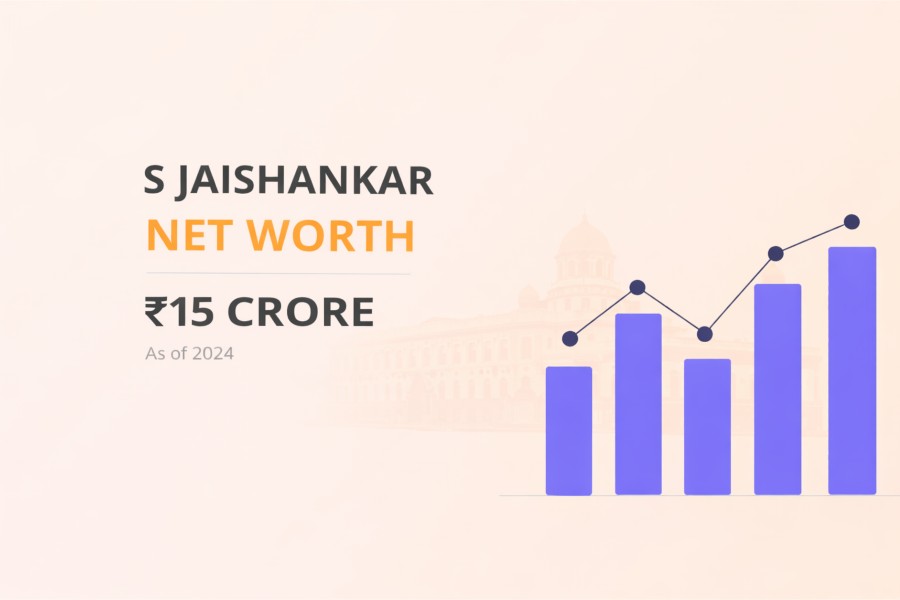
As per the affidavit filed for his Rajya Sabha nomination, S. Jaishankar’s net worth stands at a respectable albeit modest figure when compared to the billionaire-politicians of the Parliament. However, it is significantly higher than the average bureaucrat, largely due to his post-retirement tenure as President of Global Corporate Affairs at Tata Sons. This role, which he held before joining the Modi cabinet, provided a significant boost to his financial standing, adding a layer of corporate wealth to his government pension and savings. This report offers a forensic analysis of S. Jaishankar’s net worth, dissecting the "Clean Wealth" of India’s top diplomat and examining how intellectual capital translates into financial security.
The Corporate Multiplier: The Tata Sons Era
From IFS to Inc.
The defining feature of S. Jaishankar’s financial narrative is the "Corporate Multiplier." After retiring as the Foreign Secretary of India, Jaishankar did not immediately fade into the sunset of a pensioner's life. Instead, he joined Tata Sons, the holding company of the massive Tata Group, as President of Global Corporate Affairs. This was a strategic role that leveraged his immense geopolitical network to guide one of India’s largest conglomerates.
The Salary Bump
While government salaries for top bureaucrats are capped in the range of ₹2.5 Lakhs per month (plus perks), corporate compensation at the leadership level of Tata Sons is in a different stratosphere. During his brief tenure there, Jaishankar would have earned a multi-crore salary package, accompanied by stock options or performance bonuses typical of C-suite executives. This period allowed him to accumulate significant movable assets—bank deposits and mutual funds—that far exceed what a lifetime of government service alone could provide. This "white money" injection is what propels his net worth into the double-digit crore bracket.
Asset Breakdown: The Diplomat's Portfolio
01. Movable Assets & Investments
Jaishankar's portfolio is heavily weighted towards financial assets rather than physical ones. This liquidity preference is characteristic of global professionals who value mobility and flexibility over the static nature of land ownership.
Stocks & Mutual Funds
Equity Exposure: Unlike conservative politicians who stick to Fixed Deposits, Jaishankar’s affidavits declared substantial investments in equities and mutual funds. His returns from these market-linked instruments reflect a sophisticated understanding of global finance.
Diversification: The portfolio is diversified across various asset classes, reducing risk. This aligns with his professional persona of risk management and strategic hedging.
Bank Deposits
High Liquidity: A significant portion of his wealth is held in bank deposits across Indian and possibly international accounts (from his diplomatic tenure, declared as per norms). This provides him with immediate liquidity and financial security.
Retirement Corpus: The deposits also include the accumulated benefits from his decades of service in the IFS, including PF and Gratuity.
Immovable Property
Delhi & Tamil Nadu: His real estate holdings are pragmatic. He owns a residential property in Vasant Vihar, New Delhi—one of the city's most upscale neighborhoods—jointly with his wife, Kyoko Jaishankar. This property alone accounts for a significant chunk of his asset value due to the high real estate prices in South Delhi.
Ancestral Connections: There are also declarations of property in Tamil Nadu, linking him to his ancestral roots, though these are likely inherited or acquired earlier in his career.
Personal Effects
Modest Jewelry: The jewelry declared by the Jaishankar family is modest and largely traditional. There are no declarations of ostentatious diamond sets or bullion hoards.
Functional Assets: His vehicle declarations are typically utilitarian, avoiding the luxury fleets of BMWs or Land Rovers often seen in political convoys.
The "Kyoko" Factor: A Global Partnership
Joint Assets
A significant portion of S. Jaishankar’s assets are held jointly with his wife, Kyoko Jaishankar. Of Japanese origin, she has been a partner in his global journey. The joint ownership of prime real estate in Delhi signifies a shared financial destiny. The multicultural aspect of his family (with children living and working abroad) also suggests a global outlook on wealth, likely involving compliance with international financial norms (FATCA, etc.) which adds a layer of scrutiny and transparency to his declarations that typical regional politicians do not face.
Comparative Financial Landscape
To understand where S. Jaishankar stands, one must compare him not with grassroot politicians, but with the technocratic elite.
- Asset Source: Salary + Corporate Bonus
- Investment Style: Market Savvy / Diversified
- Residence: Upscale South Delhi
- Net Worth: ~₹15 Cr+
- Vibe: Global CEO / Technocrat
- Asset Source: Real Estate / Agriculture
- Investment Style: Land Hoarding / Cash
- Residence: Multiple Farmhouses
- Net Worth: ₹50 Cr - ₹500 Cr+
- Vibe: Feudal Landlord
Intellectual Capital: The "Invisible" Asset
While his tangible net worth is in the range of ₹15-20 Crores, S. Jaishankar possesses an "Invisible Asset" of immense value: his Intellectual Capital. As one of the world's most respected strategic thinkers, his post-political career potential is staggering. Speaking engagements at global forums (Davos, think tanks), advisory roles for multinational corporations, and book deals (his book "The India Way" was a bestseller) represent a future income stream that could easily dwarf his current accumulated wealth. In the global market of ideas, Jaishankar is a blue-chip stock.
Conclusion: The Technocrat's Ledger
S. Jaishankar’s net worth is a clean, explainable, and meritocratic figure. It lacks the smoky ambiguity of "undisclosed sources" or "agricultural income" that plagues many political affidavits. It is the balance sheet of a man who reached the pinnacle of his profession, pivoted to the corporate world to cash in on his expertise, and then brought that financial security back into public service. His wealth gives him independence; he does not need politics to make money, which makes him a formidable and incorruptible figure in the cabinet.
Frequently Asked Questions
Based on his affidavits filed during Rajya Sabha nominations, his declared family assets are estimated to be between ₹15 to ₹20 Crores. This includes both movable and immovable assets held jointly with his wife.
Yes. His tenure as President of Global Corporate Affairs at Tata Sons was a high-paying leadership role. The income earned during this corporate stint significantly boosted his movable assets and investments unlike a standard government pension.
His public affidavits primarily list properties in India (Delhi and Tamil Nadu). While he has lived abroad for decades as a diplomat, his permanent asset base is declared in India.
He is considered moderately wealthy—richer than the "social worker" politicians but far behind the "industrialist" politicians like Piyush Goyal or Jyotiraditya Scindia. He represents the upper-middle-class professional elite.