Introduction
Chetan Bhagat is not merely an author; he is a cultural phenomenon in modern India. Often credited with reviving the reading habit among the country's youth, he transformed the Indian publishing landscape with his simple, conversational storytelling. However, his influence extends far beyond the printed word. As a screenwriter, columnist, television personality, and motivational speaker, Bhagat has built a diversified "Content Empire" that generates revenue from multiple streams. His journey from an investment banker at Goldman Sachs to one of India's highest-paid authors is a masterclass in personal branding and understanding the pulse of the emerging Indian middle class.
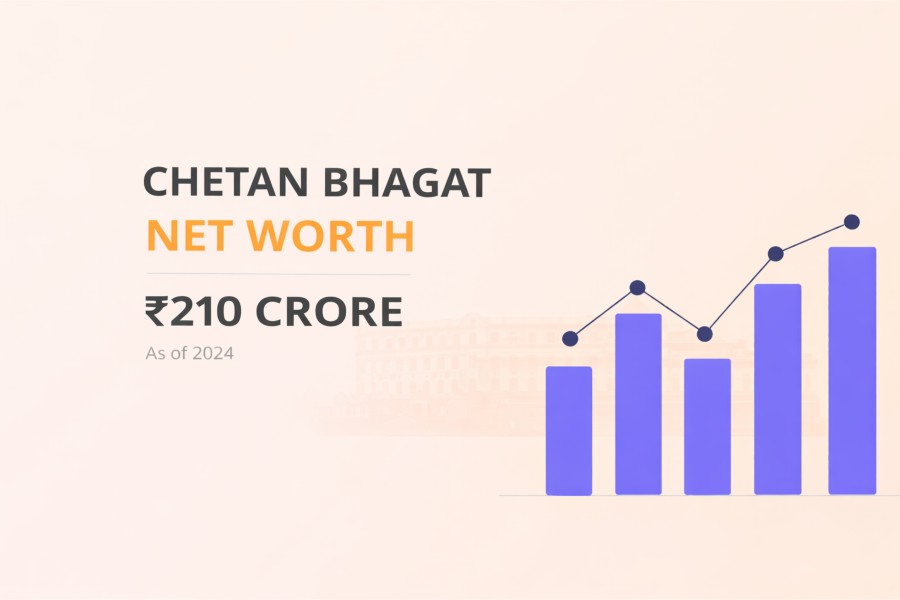
This comprehensive analysis dissects Chetan Bhagat's net worth, estimated to be substantial and growing. We move beyond the royalties of bestsellers like *Two States* and *3 Idiots* to explore the intricate financial ecosystem of his career. We examine his movie rights, his lucrative speaking engagements, his syndicated columns, and his investments. By analyzing his career trajectory, we uncover how an IIT-IIM graduate leveraged his education not to become a corporate suit, but to become the voice of a generation, amassing a fortune that rivals some of the biggest celebrities in Bollywood.
The Literary Juggernaut: The Foundation of Wealth
The "Paperback Revolution" Economics
To understand Bhagat's wealth, one must understand the economics of mass-market publishing in India. Before Chetan Bhagat, Indian English fiction was largely niche, academic, or high-brow. Bhagat broke this barrier with *Five Point Someone*. He wrote in "Hinglish"—a blend of Hindi and English that resonated with the college-going demographic. This accessibility was his golden ticket.
His books sell in volumes that are unprecedented for an Indian author. We are talking millions of copies sold. In the publishing world, an author typically earns a royalty of 10% to 15% on the cover price of a paperback. With a cover price averaging ₹250-350 and sales running into millions for titles like *2 States* and *Half Girlfriend*, the royalty checks are massive. Furthermore, his backlist—his older books—continue to sell steadily. Unlike a tech product that becomes obsolete, *Five Point Someone* is still in high circulation, acting as a perpetual annuity for his net worth. This backlist value is a critical component of his financial stability, ensuring cash flow even between new releases.
-
Royalties and Advances Passive Income
Bhagat commands some of the highest advances in the Indian publishing industry. For his newer titles, publishers pay a significant upfront sum just to secure the rights, independent of future sales. This advance mitigates risk for the author. Combined with the continuous stream of royalties from domestic sales and translations (his books are translated into almost every major Indian language), the literary arm of his empire is the bedrock of his net worth, providing a reliable multi-crore annual income.
-
Global Reach and Translations Expansion
While his core audience is India, his books are published internationally. The translation rights for languages like French, Spanish, and Japanese add a layer of foreign currency earnings. Though smaller in volume compared to English sales in India, these international deals add prestige and incremental revenue. The global appeal of the "Indian College Life" narrative, popularized by movies like *3 Idiots*, drives these foreign sales.
The Bollywood Multiplier: Movies and Screenwriting
From Page to Screen: The Lucrative Adaptation Rights
If books are the root of his wealth, Bollywood is the fertilizer that made it grow exponentially. Chetan Bhagat is perhaps the only Indian author whose name is often treated as a genre in itself. Production houses queue up for the rights to his novels because they come with a ready-made fan base and a proven story structure.
The sale of movie rights is a one-time windfall, but it is a massive one. For a bestseller like *2 States* or *Half Girlfriend*, the rights could easily sell for ₹1 Crore to ₹5 Crores, depending on the buzz and the production house involved. However, Bhagat's smart financial move was not just selling the rights but retaining a role in the creative process. By moving into screenwriting, he secured a credit and potentially a share of the profits or a substantial screenplay fee. Films like *Kai Po Che!* (based on *The 3 Mistakes of My Life*) and *3 Idiots* (loosely based on *Five Point Someone*) grossed hundreds of crores at the box office. While authors rarely get a cut of box office collections unless they are co-producers, the association with such blockbusters skyrockets the author's brand value, allowing them to command higher fees for their *next* project.
Screenwriting Fees and Script Doctoring
Bhagat moved beyond just adaptations. He wrote the script for the Salman Khan starrer *Kick* and *Satyameva Jayate*. A top-tier screenwriter in Bollywood commands fees in the range of ₹2-5 Crore per film, plus bonuses if the film is a hit. By establishing himself as a bankable writer who understands the "masala" as well as the "message," Bhagat tapped into a revenue stream that is far more lucrative per hour of work than writing a novel. A novel takes a year; a script might take six months, but the paycheck is often immediate and substantial.
The Media Mogul: Columns and Television
The Syndicated Columnist
Chetan Bhagat is a ubiquitous presence in Indian media. His columns in *The Times of India* and *Dainik Bhaskar* (Hindi) reach millions of readers every week. Syndication is a powerful income generator. Major publications pay handsomely for exclusive content that drives engagement. His columns, often covering socio-political issues, generate debate and traffic, making him a valuable asset for digital media houses.
Furthermore, his content is republished across various digital platforms owned by these media conglomerates. In the digital age, views translate to ad revenue. While an individual author's cut of ad revenue is hard to quantify, his clout allows him to negotiate contracts that likely include retainers or performance bonuses based on readership metrics. This "thought leadership" position also indirectly boosts his book sales, creating a virtuous cycle.
Television Appearances and Judging Shows
Bhagat has ventured into television as a judge on reality shows like *Nach Baliye* and as a participant in shows like *Bigg Boss* (as a visitor/promoter). Appearance fees for celebrity judges on prime-time reality shows can run into lakhs per episode. If a show runs for 12-15 weeks, the total payout is significant. Additionally, these appearances serve as marketing platforms for his upcoming books or movies, making the investment of time highly efficient.
The Speaking Circuit: Motivation and Keynotes
One of the most profitable, yet often invisible, streams of income for public intellectuals is the speaking circuit. Chetan Bhagat is a sought-after keynote speaker at corporate conferences, college fests (like IITs and IIMs), and leadership summits.
Globally, top authors charge between $20,000 to $50,000 for a keynote. In India, while the numbers are lower, A-list celebrities and authors can command ₹10 Lakhs to ₹25 Lakhs per speech. Considering Bhagat speaks at dozens of events annually, this stream likely adds several crores to his annual income. His speeches, often focusing on youth motivation, success mantras, and national issues, are perfectly tailored for the corporate and educational sectors that have budgets for such engagements.
Lifestyle, Assets, and Expenditure
The Mumbai Life
Chetan Bhagat resides in Mumbai, the hub of India's media and entertainment industry. He owns a luxurious apartment in one of Mumbai's premium high-rises. While the exact value is not public, properties in the areas he is known to reside in (like Andheri or Powai) are valued in the range of ₹5 Crore to ₹10 Crore.
Education and Family Investments
Bhagat is married to Anusha Suryanarayan, whom he met at IIM Ahmedabad. A significant portion of his wealth is invested in the education and upbringing of his two sons. He has openly discussed sending his children to the Dhirubhai Ambani International School, one of the most expensive schools in Mumbai. Annual fees for such institutions can run upwards of ₹10 Lakhs per child, indicating a high disposable income and a focus on quality education as a primary asset class.
Unlike some celebrities who flaunt fleets of luxury cars, Bhagat's public persona is relatively grounded. However, it is safe to assume he holds a collection of premium vehicles suitable for his status, though he maintains a "middle-class guy made good" image that likely curtails excessive displays of wealth. His investment portfolio likely includes a mix of real estate, equity mutual funds (given his finance background), and fixed deposits to manage the tax liabilities of his high income.
Comparative Analysis: Bhagat vs. Peers
How does Chetan Bhagat stack up against other Indian literary giants?
| Author | Primary Revenue Stream | Net Worth Estimate | Commercial Reach |
|---|---|---|---|
| Chetan Bhagat | Books + Movies + Speaking | ~$30M - $50M (₹250-400 Cr) | Mass Market (Youth) |
| Amish Tripathi | Books + Series Rights | ~$5M - $10M | Fantasy/Mythology Niche |
| Vikram Seth | Classics (Royalties) | ~$20M - $30M | Literary/High-brow |
| Ashwin Sanghi | Books (Dan Brown of India) | ~$3M - $5M | Thriller Niche |
Bhagat's net worth is significantly higher than his contemporaries in the Indian commercial fiction space. This is primarily due to the "Bollywood Factor." While Amish Tripathi has massive sales, the movie adaptations of his books are still catching up to the cultural impact of *3 Idiots* or *2 States*. Bhagat's ability to pivot into screenwriting and television gave him a first-mover advantage in monetizing his IP (Intellectual Property) across media verticals.
Brand Endorsements and Future Ventures
Unlike cricketers or actors, authors rarely do brand endorsements. However, Chetan Bhagat has dabbled in this space, endorsing educational platforms like "Unacademy." Associating with the ed-tech sector, which boomed during the pandemic, was a strategic financial move. Endorsement deals for top-tier celebrities in India can range from ₹1 Crore to ₹5 Crore per year per brand.
Looking ahead, Bhagat's net worth is poised to grow. He is actively building his presence on YouTube and social media, platforms that offer direct monetization through ads and sponsorships. As the digital content economy in India explodes, his ability to translate his thoughts into bytes will likely become a major revenue generator, further diversifying his income away from the traditional print medium.
Conclusion: The Business of Storytelling
Chetan Bhagat's net worth is a testament to the commercialization of storytelling in 21st-century India. He proved that writing could be a lucrative career if one understands the market. He did not just write books; he wrote products that were easily adaptable to the screen, discussable in columns, and performable on stage. His IIT-IIM background equipped him not just with the discipline to write, but with the financial acumen to diversify his revenue streams.
From the modest royalty checks of *Five Point Someone* to the multi-crore deals of *Kick* and his global speaking tours, Bhagat has built a financial empire that is robust, resilient, and remarkably scalable. He is the premier example of the "Creator Economy" in India—a man who turned his thoughts into a multi-million dollar brand. As he continues to evolve from a novelist to a public intellectual, his wealth will likely continue to reflect the immense value he provides to the Indian entertainment and media industry.
Frequently Asked Questions
While exact figures are private, estimates place Chetan Bhagat's net worth between $30 Million and $50 Million USD (approximately ₹250 Crore to ₹400 Crore). This valuation accounts for his book royalties, movie rights, screenwriting fees, and assets.
Earnings per book vary. He receives a significant advance ( rumored to be ₹50 Lakhs to ₹1 Crore for new titles) plus royalties. For a bestseller selling a million copies, royalties alone can exceed ₹2-3 Crores over the book's lifecycle.
While *3 Idiots* was the biggest hit, it was loosely based on his book, and the rights sale for that specific adaptation was early in his career. Films like *2 States* and *Half Girlfriend*, where he was more directly involved in the screenplay and adaptation process, likely yielded higher financial returns due to better negotiation leverage and combined fees.
He is primarily a creator. However, his role involves investing in his own brand production and content creation. He is not known to own traditional businesses like factories or retail chains, focusing instead on the intellectual property sector.
He is arguably one of the richest contemporary authors in terms of liquid assets and annual income due to his diverse revenue streams. While authors with heritage properties (like descendants of royal families or industrialists who write) might have higher net worth, Bhagat is likely the wealthiest "self-made" author in the commercial fiction genre.
Final Financial Overview
Chetan Bhagat's financial journey mirrors the aspirations of the very characters he writes about—ambitious, middle-class Indians striving for success. He cracked the code of the Indian market by blending simplicity with mass appeal. His net worth is not just a number; it is a metric of his influence. He successfully monetized the anxieties and dreams of a generation, proving that in India, a pen can indeed be mightier—and wealthier—than a sword.