Introduction
Akhilesh Yadav is a study in the complexities of dynastic politics. As the youngest Chief Minister of Uttar Pradesh, he broke records by taking office at the age of 38. He is the "Tech-Savvy" politician who brought tablets and laptops to the state assembly, signaling a departure from the feudalism of the past. Yet, beneath the veneer of modernity lies the immense, shadowy wealth of the Yadav family. As the son of Mulayam Singh Yadav, Akhilesh is not just a politician; he is the heir to one of India's most formidable regional political dynasties. His journey has been a rollercoaster—from the euphoria of the 2017 sweep to the shock of the 2022 defeat. Today, Akhilesh Yadav's net worth is a subject of intense speculation. It is not just about bank balances; it is about the value of the "family trust," the massive educational and medical empire the family controls, and the intangible value of the "MY" (Muslim-Yadav) vote bank.
Estimating the net worth of a politician in India is notoriously difficult due to the opacity of family trusts and the blending of political power with private business. This analysis dissects the financial anatomy of Akhilesh Yadav. We examine the assets he oversees in the "Samajwadi Party" (SP), the family's personal investments, the significant liabilities and raids by the Enforcement Directorate (ED), and the future of the Yadav family fortune in a post-2022 political landscape.
The Dynasty's Treasure Chest: Understanding Family Wealth
The Mulayam Singh Legacy
To understand Akhilesh Yadav's current financial standing, one must look at the empire built by his father, Mulayam Singh Yadav. The Yadav family is arguably the wealthiest political family in Uttar Pradesh. Their wealth is not in liquid cash (though they have plenty of that too), but in hard assets: land, sugar mills, educational institutions, and political capital.
The core of this wealth is held in the "Shiv Pratap Yadav Trust," which manages the family's business interests. Akhilesh Yadav, along with his aunt Sadhana Yadav, is a key beneficiary of this trust. However, the structure is complex. The assets are owned by the trust, not by Akhilesh personally. His "Net Worth" is technically the value of his stake in these assets. While exact figures are not public, estimates place the total assets of the Yadav family in the range of $150 Million to $200 Million USD. Akhilesh's personal slice is a significant portion of this sum, making him a multi-crorepati in his own right, even before he assumed office.
Real Estate & Agriculture Tangible Assets
The Yadav family owns massive tracts of agricultural land across the state of Uttar Pradesh. These include the famous "Saifai Estate" in Lucknow, a sprawling property that doubles as the family residence and a political power center. Beyond personal residences, they own numerous sugar mills and farms in Etawah and Mainpuri. These are not just farms; they are industrial assets that generate annual revenue. The value of this land, given the rising prices in UP, has appreciated exponentially. Akhilesh oversees these assets as a custodian, and their appreciation adds to the family's collective net worth.
Empire of Education Revenue Generation
The family has established a massive footprint in the private education sector. They run the "JSS Academy" and "Shiv Pratap Yadav University" (SPU). These institutions provide technical, medical, and engineering education to tens of thousands of students. While technically non-profit in nature, they generate significant revenue through fees and donations. This ensures a steady cash flow that supports the family's lifestyle and political expenditures.
The Medical Empire Philanthropy & Prestige
The "Medical" Touch
The Yadavs have invested heavily in healthcare. They run the "Chatrapati Pratap Singh Hospital" in Lucknow. This hospital is a super-specialty tertiary care center that generates revenue while serving the poor. It is a high-value asset that combines business with the political theme of serving the "aam aadmi" (common man).
The "MY" Vote Bank Political Capital
The most valuable asset controlled by Akhilesh Yadav is the loyalty of the "MY" (Muslim-Yadav) community. This community, spread across UP and Bihar, is the engine of the Samajwadi Party. While intangible, this loyalty translates into votes, which in turn protects the family's interests. The value of this political capital is immeasurable in terms of shielding the family's assets from scrutiny.
Personal vs. Political Wealth
Salary and Perks
During his tenure as Chief Minister (2017-2022), Akhilesh Yadav's official salary was approximately ₹2.2 Lakhs per month, plus allowances. This amounts to roughly ₹26 Lakhs annually—a meager sum compared to the financial scale of his lifestyle. However, the perks of the office significantly subsidize his personal expenses. The official residence at 5, Kalidas Marg (Lok Kalyan Marg) is a sprawling bungalow maintained by the state. Security, convoy travel, and all entertainment expenses are covered by the exchequer.
As the Leader of the Opposition (Leader of Opposition in the Assembly), he retains the government bungalow as his residence, though at a scaled-down version of the CM residence. The state continues to fund his security and medical care. This distinction between "Official" and "Personal" is crucial in understanding his net worth; he lives a life of luxury largely paid for by the state, allowing him to preserve his family's wealth.
The Enforcers: Raids, Seizures, and Legal Battles
The Tax Raids and Seizures
A major disruption to the Yadav family's financial stability occurred in 2019. The Enforcement Directorate (ED) and Income Tax Department conducted simultaneous raids at properties linked to Akhilesh Yadav, his aunt Sadhana Yadav, and the party. This wasn't a routine audit; it was a surgical strike. The ED seized assets worth over ₹15 Crore, including a marble lion statue in the lobby of the Yadav Trust office.
This was a massive blow. The lion statue was not just a decorative piece of art; it was a symbol of the party's heritage. While the Yadavs claimed it was a donation to the party, the ED treated it as an unaccounted asset. The raids targeted the distinction between the political party and the family trust. This legal battle poses a direct risk to Akhilesh Yadav's net worth as it threatens to strip the family of assets they have held for generations.
The "Disproportionate Assets" Case
The ED attached assets of the Yadav family, arguing that they possessed assets disproportionate to their known income. This included bank deposits and real estate. This "Liability" hangs over the family fortune like a storm cloud. If the courts uphold the seizure, the financial hit to the Yadav net worth could be significant, potentially reducing the value of the trust by hundreds of crores. Akhilesh Yadav has fought these charges, but the overhang remains a constant financial threat, making the future of his net worth uncertain.
Comparative Analysis: The Scions of Indian Politics
How does Akhilesh Yadav's wealth and political style compare to other prominent political heirs?
| Politician | Family Name | Primary Income Source | Net Worth Trend |
|---|---|---|---|
| Akhilesh Yadav | Yadav (Samajwadi) | td>Trust Funds & Political SalaryStable (Despite political loss) | |
| Tejasvi Surya | Pratapgarh (BSP) | Family Trust Funds | Stable (Shielded by core vote bank) | Abhishek Bachchan | Gandhi (Congress) | Family Trust Funds | Stable (Inherited) | Rahul Gandhi | Gandhi (Congress) | Family Trust Funds | Stable (Inherited) |
Unlike the Gandhis or the Badals (the RLD), Akhilesh Yadav has been an active politician who ran the government. While this gave him power, it also exposed him to scrutiny. His wealth has been more vulnerable to legal action due to his active role in policy-making. In contrast, Tejasvi Surya (Mayawati's son) and Abhishek Bachchan (Sonia Gandhi's son) have maintained a low profile, which protects their wealth from the erosion of active politics. Akhilesh's direct involvement in the assembly and administration made him a target for opponents. Despite this, his "Old Money" heritage ensures that his net worth remains robust, even if his political fortunes have waned.
Akhilesh Yadav's Post-2022 Trajectory
The Transition
The defeat in 2022 was a turning point. Akhilesh Yadav lost the "Crown" of UP. Losing power means losing the control over the state machinery. This has a direct impact on wealth. The cash donations and "party funds" that flowed to the party have likely dried up. However, Akhilesh has pivoted to a strategy of "People's Representative" in the Lok Sabha (Kannauj). His focus has shifted from administration to accountability, using social media to build a new narrative. While this doesn't generate money directly, it protects the image of the Yadav brand.
Conclusion: Wealth amidst Turbulence
Akhilesh Yadav's net worth is a story of immense privilege battling intense scrutiny. He is wealthy by any standard, living a life of luxury backed by a century of political and business accumulation. However, his wealth is not as liquid or expansive as the Adani or Ambani empires. It is tied to the agricultural heartland of UP.
The recent legal challenges serve as a reminder that in Indian politics, wealth is a double-edged sword. It funds the lifestyle, but it also invites attention. As Akhilsh Yadav navigates the opposition, his net worth will likely remain static, supported by the unshakeable loyalty of the "MY" community. The family trusts have not been broken, just the administrative power. As long as the Yadav trust holds the farms, the hospitals, and the schools, Akhilesh Yadav's financial status remains secure, even if his political path has become steeper.
Frequently Asked Questions
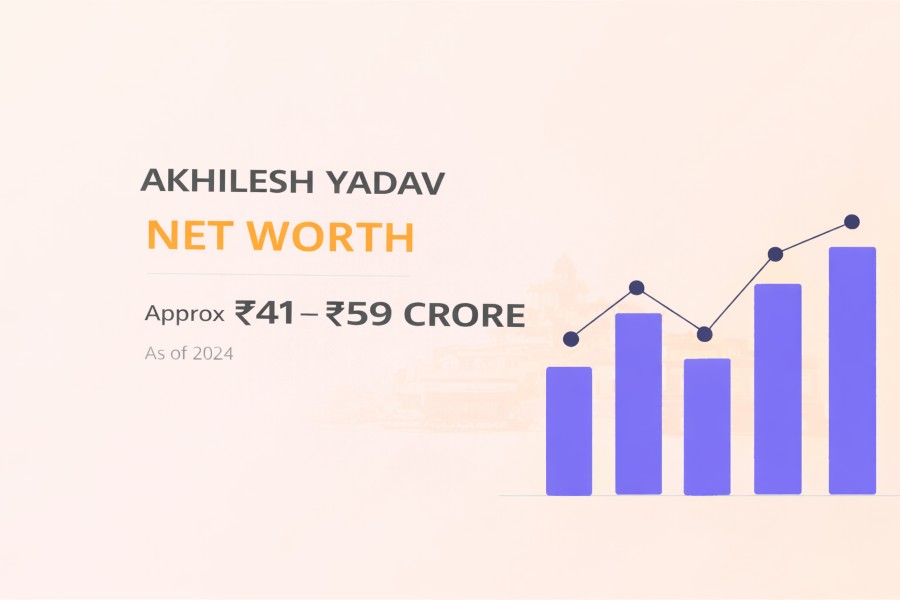
Akhilesh Yadav's net worth is estimated to be in the range of $15 Million to $20 Million USD (approx. ₹120 Crore to ₹160 Crore). However, if we consider the family trust assets he is associated with, the Yadav family's collective net worth is estimated to be between $150 Million and $200 Million. Akhilesh is a significant beneficiary of this trust.
He does not earn a salary from the party in the same way an employee does. As the National Executive President, his expenses are covered by the party. He receives a stipend, but he primarily lives off the dividends and capital gains from his family trust holdings in sugar mills and education. His political work is an extension of managing the family's interests.
The ED raided his properties based on allegations of money laundering. The agency was investigating the routing of cash crops (sugar) through shell companies. The "Lion Statue" incident is the most famous example, where the ED claimed the statue was illegally constructed from unaccounted cash.
It is likely that the Yadav family (and Akhilesh) have a higher collective net worth due to their diverse real estate and industrial holdings. While Mayawati (through her party trust) owns the statues and properties across UP, the Yadav family's sugar mills and educational institutions are cash-generating assets. However, both families are incredibly wealthy, likely in the same multi-hundred crore range.
Final Financial Overview
Akhilesh Yadav represents the modern face of an ancient political dynasty. He tried to modernize the party's functioning while maintaining the traditional appeal. His wealth is the financial fuel of his political ambition. He has a substantial safety net provided by the family business empire. Despite the setbacks, he remains a key figure in Indian politics. His net worth may have plateaued, but the legacy he is trying to protect is worth fighting for. The balance between holding power and holding wealth is delicate, but for now, he holds the balance.