Mamata Banerjee, the fiery Chief Minister of West Bengal and the supremo of the Trinamool Congress (TMC), presents one of the most culturally significant financial profiles in modern Indian politics. Known affectionately as "Didi" (Elder Sister), she has cultivated an image of extreme austerity that borders on the ascetic. In an era where political power is often synonymous with private jets, luxury SUVs, and sprawling farmhouses, Banerjee’s public persona is defined by her trademark white cotton saree with a blue border, rubber flip-flops (chappals), and a resolute refusal to accept the trappings of her high office. Her financial audit is, therefore, not just a calculation of assets, but a study of a unique brand of "Political Mysticism" where the rejection of material wealth serves as the ultimate currency of power.
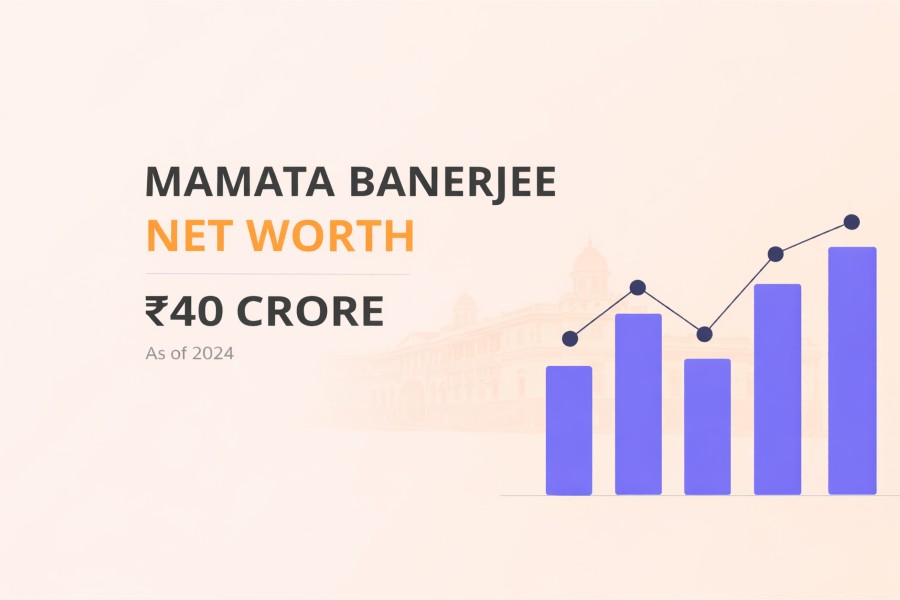
According to her election affidavits, particularly the one filed for the 2021 West Bengal Assembly elections, she is statistically one of the "poorest" Chief Ministers in India. With no declared immovable properties in her name—no house, no land, no commercial buildings—and a movable asset portfolio that would be considered modest even for a lower-middle-class citizen, her net worth stands in stark contrast to the multi-crore portfolios of her contemporaries. However, this narrative of personal penury exists alongside the massive, capital-intensive machinery of her party and the significant controversies regarding financial scams (like Saradha and Narada) that have engulfed her administration. This report provides a deep-dive forensic analysis of Mamata Banerjee’s net worth, examining the reality behind the "symbolism of simple living" and the economics of her political survival.
The Economics of "Didi": Income and Sources
Refusal of Official Salary
One of the most unique aspects of Mamata Banerjee’s financial profile is her rare distinction of refusing the official salary and allowances entitled to her as a Chief Minister and previously as a Member of Parliament. While most politicians rely on these funds as their primary legitimate income, Banerjee has famously foregone crores of rupees over her career. This act of financial renunciation is central to her brand, reinforcing the idea that she serves for the people, not for the pay.
Royalties: The Artist and Author
If she refuses her salary, how does she sustain herself? The answer lies in her creative output. Mamata Banerjee is a prolific author and painter. She has penned over 100 books in Bengali and English, ranging from political memoirs to poetry. The royalties from these publications form the bulk of her declared income. Additionally, her paintings have been sold at various exhibitions (though this has also been a source of controversy regarding the buyers). In her 2021 affidavit, she declared a total income of approximately ₹10 Lakhs for the financial year, derived almost entirely from these creative royalty sources. This model of "Self-Sustenance" distinguishes her from politicians who rely on agriculture or family businesses.
Asset Breakdown: The Audit of Austerity
01. Movable Assets & Liquidity
A detailed look at her 2021 affidavit reveals a portfolio that is shockingly lean for a two-time Chief Minister. The total value of her movable assets stood at roughly ₹16.72 Lakhs. This figure is lower than the average assets of a typical urban salaried employee in Kolkata.
Bank Deposits & Cash
Cash in Hand: She declared having roughly ₹69,000 in cash. This is a functional amount, likely for daily charitable giving or minor expenses.
Bank Balance: Her bank deposits across various accounts (including SBI and HDFC) amounted to approximately ₹13.5 Lakhs. This liquidity is her primary financial safety net.
Investments: She holds National Saving Certificates (NSC) worth mere amounts, and notably, she has zero investments in stocks, mutual funds, or insurance policies. Her risk appetite is non-existent.
Jewelry Holdings
Minimalist Gold: Unlike the heavy gold accumulation seen in the portfolios of other female politicians like Mayawati or Jayalalithaa (historically), Mamata Banerjee owns very little jewelry. She declared roughly 9 grams of jewelry, valued at less than ₹50,000 at the time.
No Diamonds: There are no high-value stones, diamonds, or antique silver sets declared. Her personal adornment is strictly limited to her functional watch and simple accessories.
Immovable Property
The Kalighat Residence: Perhaps the most surprising entry is the "Nil" declaration under immovable property. Mamata Banerjee does not own the house she lives in. The single-storey, tile-roofed house on Harish Chatterjee Street in Kalighat is her ancestral home.
No Land Bank: She does not own agricultural land in the districts, nor does she have flats in Kolkata's posh Salt Lake or New Town areas. She is, legally speaking, a tenant in her own city.
Vehicles
Zero Vehicles: Mamata Banerjee does not own a car. She travels in state-provided security convoys or, famously, used to travel in a humble Hyundai Santro or even on the pillion of a motorcycle during her opposition days.
Total Mobility: Using state machinery for official duties eliminates the need for personal vehicle ownership, further depressing her declared asset value.
The Paradox: Personal Poverty vs. Party Wealth
The Cost of Politics
While her personal balance sheet is lean, the Trinamool Congress (TMC) which she controls is a cash-rich political machine. The Association for Democratic Reforms (ADR) reports often highlight TMC as one of the wealthier regional parties, with significant income from electoral bonds and donations. Critics argue that a leader does not need personal wealth if the party coffers are full and at their disposal. The ability to charter helicopters for campaigning, organize massive rallies at the Brigade Parade Ground, and fund district-level operations requires hundreds of crores. Thus, her "Net Worth" is arguably the "Net Worth of the TMC," over which she holds absolute command.
Controversies on "Proxy Wealth"
The opposition, particularly the BJP and CPIM, frequently allege that while "Didi" remains poor, her family members (nephews and brothers) have amassed significant fortunes. The "Abhishek Banerjee" factor—her nephew and political heir—is often cited, with allegations of rapid accumulation of real estate and assets. Opposition leaders often term this as the "Bua-Bhatija" model, implying that the austerity of the aunt provides a moral shield for the accumulation of the nephew. However, legally, Mamata Banerjee has maintained a strict separation of households and assets in her declarations.
High-Value Art or Money Laundering?
The Painting Controversy
A specific financial controversy that dogged her was the sale of her paintings. During the investigation into the Saradha Chit Fund scam, it was alleged that Sudipta Sen (the scam kingpin) bought one of Mamata Banerjee’s paintings for ₹1.86 Crore. Critics labeled this as a method to launder money or buy political patronage under the guise of art appreciation. While Banerjee has staunchly defended her art as a legitimate creative expression used to fund party activities and charity, the valuation of these paintings remains a polarizing topic in her financial narrative.
Comparative Financial Landscape
Mamata Banerjee represents the extreme left of the wealth spectrum among Indian Chief Ministers.
- Asset Source: Book Royalties
- Residence: Ancestral House (Tile Roof)
- Vehicle: None (Walks/State Car)
- Net Worth: ~₹16.72 Lakhs
- Vibe: Street Fighter / Ascetic
- Asset Source: Real Estate / Industry
- Residence: Palatial Bungalows
- Vehicle: Luxury Fleets
- Net Worth: ₹100 Cr - ₹500 Cr+
- Vibe: Corporate CEO / Feudal
Future Financial Security
Mamata Banerjee is unmarried and has no direct descendants. This removes the primary motivator for wealth accumulation: inheritance. Most politicians amass wealth to pass on to their children. Banerjee’s lack of a direct heir (though she has a nephew in politics) reinforces her indifference to personal asset creation. Her future security is essentially guaranteed by her status as a former MP and CM, which entitles her to lifelong pension, medical care, and security. She effectively needs zero personal capital to survive.
Conclusion: The Power of Having Nothing
Mamata Banerjee’s net worth of ₹16.72 Lakhs is a powerful political weapon. In a country where corruption is a central electoral issue, her ability to present empty hands to the electorate is her strongest defense. It silences accusations of personal greed. While questions linger about the wealth of her extended family and the funding of her party, her personal affidavit remains unblemished by excess.
She represents a dying breed of "Conviction Politicians" who view money not as a goal, but as a distraction. Her wealth is not measured in the gold she owns, but in the frenzy of the crowds she commands. In the auditing of Indian politics, Mamata Banerjee stands as a unique case study where Net Worth is inversely proportional to Political Capital.
Frequently Asked Questions
As per her 2021 election affidavit, her declared net worth is approximately ₹16.72 Lakhs. This consists entirely of movable assets like bank deposits and jewelry.
No. She lives in her ancestral home at 30B Harish Chatterjee Street, Kolkata. She does not own the title to this property in her individual capacity as per her declaration.
She has stated that she does not need the salary to sustain her simple lifestyle and prefers to contribute it to the state exchequer or relief funds, relying instead on royalties from her books and art.
Her primary declared source of income is royalty from the books she has written and, previously, the sale of her paintings.